Earlier this week I attended another open session of Evanston’s Environmental Equity Investigation (EEI) project. It was unfortunately sparsely attended (my perception) by community members. Maybe 10-15 community folks, about 1/3rd the participation of a previous session.
Unfortunate in part because the session was well designed and facilitated and could have easily accommodated 40-50 real community members. The design gave folks a chance to have good small group conversations, share stories and ideas and experiences.
It also included options for participants to share individual experiences: An option to be interviewed (recorded) to tell their environmental equity stories and an option to fill out a open-text questionnaire. I opted for the questionnaire and was pleased to see that, after asking for a general statement about personal experiences with environmental equity issues, it asked the participant to share one specific experience (story) to illustrate the statement.
A packed room of community members would have generated rich feedback on issues, and many stories and experiences. The EEI leaders are holding a second, Zoom session to bring in more voices.
Yet still. This is one flaw in our reliance on this style of community meeting for public engagement and discovering stories about lived experiences. What if we design a great event, and no one really shows up?
We can unpack this challenge in a number of ways – event timing, location, communication, etc. – but an underlying truth remains the same. These meetings have limitations. Especially when participants are asked to attend to give us feedback on our thinking and to share stories about how their experiences fit into our thinking.
More on addressing that challenge, below. But I do want to highlight one reason to gather together like this: We can explore data, analyses and meaning together. It’s about what we learn.
The recent EEI meeting was part of a series of community outreach activities designed to take a broad exploration of environmental equity and then narrow it down into priorities, driven by community members. Four broad areas are emerging and insights were shared at the recent meeting. The areas include traffic/pollution, sewers/flooding, housing costs and the city’s tree canopy.
These issues show a disproportionately negative impact on areas of Evanston that were redlined and the subject of other informal racial segregation practices starting in the early-mid 1900s. These areas are currently home to many Black/Brown residents. In each of the environmental equity priority issues explored at the meeting, the team shared history, data and analyses to make these issues come alive.
A great example is the city’s tree canopy. Trees provide multiple benefits in urban settings: Improving air quality, reducing heat from the built environment, helping mitigate rainfall issues, etc. They also provide a quality-of-life value.
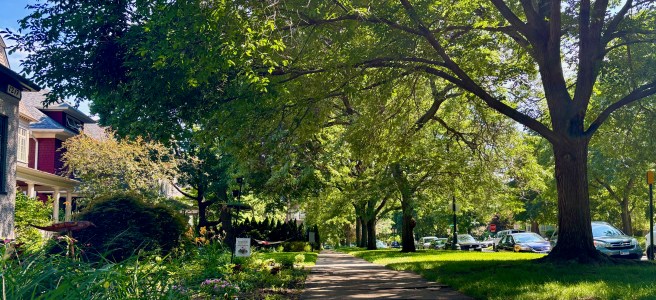
The most stunning evidence shared about inequity in the city’s tree canopy was a pair of aerial photos shared by the team running the EEI session. One view showed several blocks from one of the city’s most desirable neighborhoods (old, single family homes on large lots). Another view showed roughly the same footprint of several blocks, but it was in the part of the city impacted by historical redlining and racial segregation.
Lush vs. sparse. The photos told the story. (The photo on this post was taken in one of the desirable neighborhoods; you can get a sense of the tree canopy there.)
The team also shared data and illustrations which added to the story. Zoning codes set larger lot sizes and yard space standards in the desirable neighborhoods. An illustration comparing typical lot size and configuration in the two sections of the city demonstrated that there was at least a 25% difference in viable space for tree planting within the private property lines. The more desirable neighborhoods also had good boulevards – land between a sidewalk and the streets – where the city could plant and maintain trees (30 percent of Evanston’s tree canopy is city maintained.) The comparison neighborhoods had few – or no – viable boulevards for trees. Some lacked sidewalks until recently.
The visuals and data were first presented to the meeting attendees in a large group format. Then participants had the opportunity to move into small group conversations or activities. Each of the four priority environmental equity issues – traffic, flooding, trees, housing – had a station with a facilitator and a poster with details about the issue and how different city policies or practices affected each from an equity lens (e.g., procedural justice, distributional justice). The intent was to have participants engage in conversation and identify anything the team may have missed – positive or negative – that may effect equity.
It was an easy, natural way to explore data, analyses and meaning together.
I had a conversation with the one of the event’s consultants about the power of the tree canopy images, illustrations and data. I asked about neighborhood perception of the tree canopy and neighborhood trees: How do folks who live there actually think about the trees? She shared a story from talking to residents who lived in the sparse-canopy neighborhoods. One resident – eligible for a city-provided tree – did not want it; it’s roots might cause issues in the sidewalk and it required maintenance work on his behalf. Trees were yet another homeowner thing to deal with. Another participant in the conversation – who lives in the same neighborhood area – lost an old tree due to disease and was also eligible for a city-provided tree. “That old tree meant something to me. It was sad to see it go.” It was replaced.
Neither connected these trees to local climate and environmental impact.
The images, data and stories together painted a clearer picture of the full issue. The data and images were evidence of inequity, but also pointed to the opportunity to mitigate local environmental conditions. The stories pointed to behavior and norms that may need to be reconciled.
But all of this only came together because of a random, serendipitous moment created in small group conversation.
There were other moments in the meeting like the tree canopy aha. Perhaps this is one reason to continue pulling together such meetings. Let the folks who are energized about topics come together to create new aha moments. They learn to be better advocates and allies for the potential solution ideas that evolve.
But still, there are limitations to meetings like this. Even when they are designed to inspire both random aha moments and to collect stories of individual lived experiences, as was this most recent EEI meeting.
This is one of the key points noted by Peter Block in Activating the Common Good. Rather than relying entirely on “experts” (come give us feedback on our expert thinking, then let us create the solutions), work instead to provide resources to convene community members who then explore how to use their own capabilities to address issues. The Asset Based Community Development (ABCD) approach puts it this way: What do we already have to achieve the change we wish to see?
I would also look for ways to shift to a continuous discovery mindset (formulated by my former colleague Teresa Torres) in addition to shifting the nature of community convening. In his book, Block actually provides an example of what this might look like. One community organization created a role for “roving community listeners;” folks from the neighborhood, hired to walk the neighborhood and talk to residents about community assets and issues. It is meet people where they are, literally. The data and insights then fed group activities to further develop ideas and solutions.
The point is this. We depend far too much on a single style of community engagement: Meetings driven by an agenda framed by the the conveners. These can be designed to effectively deliver value in creating aha moments, collecting experiences, and facilitating community connection. The recent EEI meeting is an example.
But community listening deserves a richer palette of engagement styles. How do we begin to shift away from the predominant style, and toward a balanced mix of approaches that each provide different but overlapping value?
The photographs which accompany these posts are taken by me, and show different settings and views of Evanston (where I live). It is a visual reminder that this is the most important setting for belonging and contributing to community: our neighborhoods, our cities.
 Jeff Merrell
3 thoughts on “The limitation of relying on a single style of community meetings”
Comments are closed.